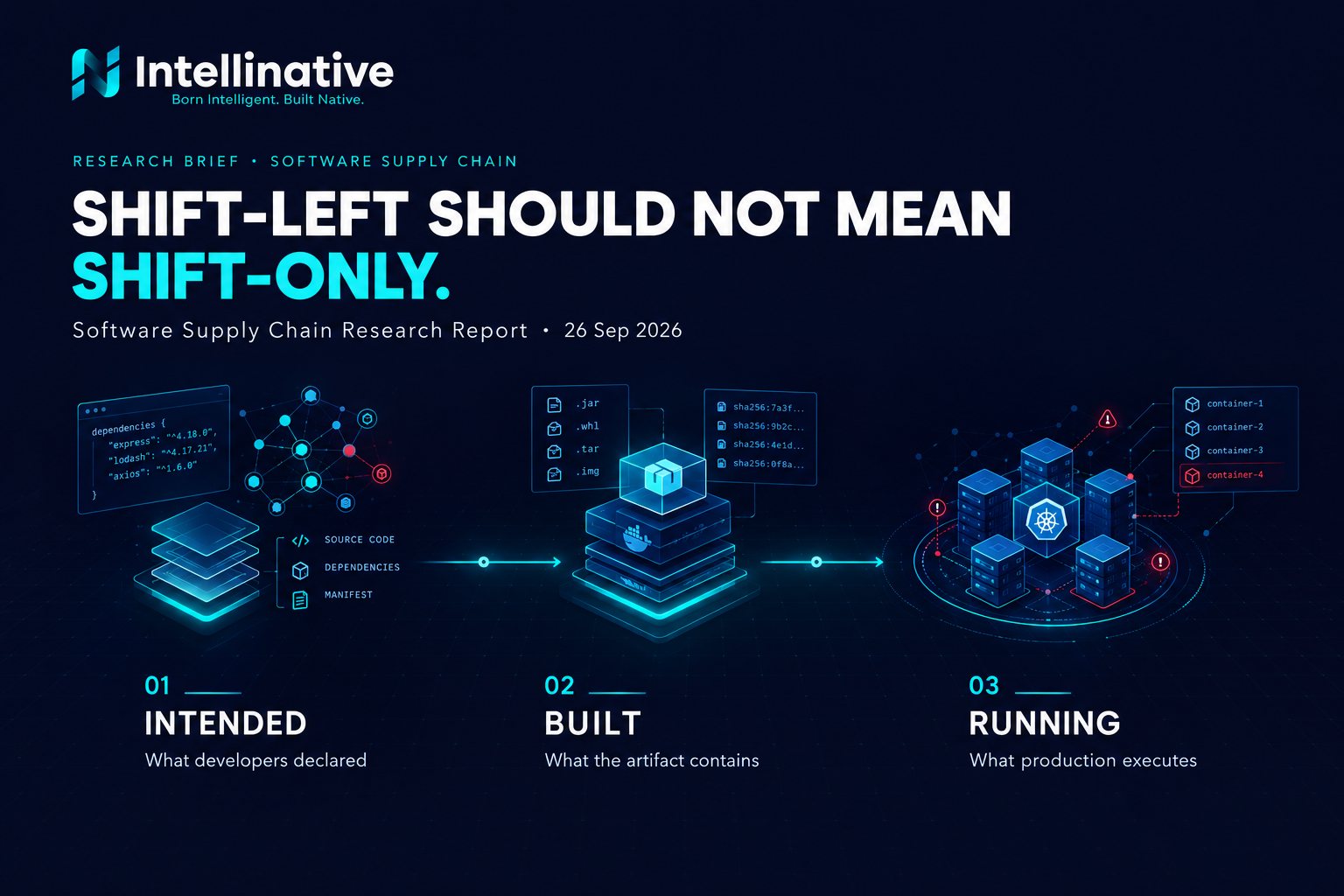
Shift-left should not mean shift-only.
This report checks one argument against published evidence: source and dependency scanning show the risk before the build, and what gets built and run can be different. The sources are CISA guidance, peer-reviewed and preprint studies, incident analyses, and vendor telemetry reports.
The 2026 data shows more components, more attacks and new reporting deadlines
These reports were published between January and September 2026. They strengthen the case for inventories that follow the artifact into production. Most of the figures are vendor telemetry or audit samples, and the source line under each one says which.
Since 11 September 2026, manufacturers have had to report actively exploited vulnerabilities and severe incidents through ENISA's Single Reporting Platform. An early warning is due within 24 hours and a full notification within 72. Goodwin notes that the duty also covers vulnerabilities in third-party components integrated into a product. Machine-readable SBOMs become mandatory from 11 December 2027.
CISA, the NSA, the FBI and international partners jointly issued the 2026 Minimum Elements after a 2025 public comment period. According to Sbomify, the 2025 draft added fields for component hash, licence and generation context. The final text was not reviewed here, so check which fields survived.
CERT-In's Technical Guidelines v2.0 (MeitY, 9 July 2025) apply to government, public sector organisations, essential services and software exporters. They encourage organisations to adopt SBOM, QBOM, CBOM, AIBOM and HBOM as "a mandatory standard practice" in procurement and software development. Section 2.2 uses banks and fintechs as its worked example, because they run a mix of COTS, open-source and custom-built software.
- §7.1.2: software supplied to government, public sector and essential services must come with a complete SBOM, in SPDX or CycloneDX (§7.1.5), using the 21 data fields in §4.2. The fields include hashes, EOL date and a unique identifier.
- §3.2: recognises six lifecycle SBOM classes, including Analyzed (inspecting final artifacts after the build) and Runtime (monitoring dynamically loaded components).
- §7.1.10: consumers map the supplier's SBOM into an internal SBOM. §7.2.12 asks them to obtain supplier assurances on its accuracy and completeness.
- §7.1.6: suppliers issue a VEX (not affected, affected, fixed or under investigation), followed by a CSAF advisory.
- §8.4.1.1: government, public sector and essential services "shall require" a CBOM and QBOM. §8.4.2.8 sets reviews at least quarterly, and §8.5.4 asks for quarterly vendor post-quantum migration reports with C-level attestation.
SEBI's CSCRF (circular of 20 August 2024) requires regulated entities to obtain and maintain SBOMs for critical systems. The requirement covers in-house, COTS and SaaS software. Legacy systems without an SBOM need a board-level risk justification.
SEBI's circular of 30 June 2025 extended the deadline for most entities to 31 August 2025. Market infrastructure institutions, KYC registration agencies and qualified RTAs were excluded from that date.
SEBI's 5 May 2026 advisory on AI vulnerability-detection tools tells all regulated entities to patch promptly, run continuous vulnerability assessments, strengthen API security and onboard to Market-SOC.
Why it matters . A 24-hour reporting window for an exploited component depends on knowing that the component is inside a shipped product. A manifest-only inventory is weak evidence for that. Neither the CRA nor CISA specifies which SBOM type to use.
Relevance. SEBI's requirement covers COTS and SaaS, where regulated entities usually have no source code. For those systems the SBOM has to come from analysing the artifact or from the vendor, so the declared-versus-shipped gaps in Findings 01–03 apply directly.
RBI has no standalone SBOM or CBOM circular. Its expectation reaches banks in two ways:
- the Master Direction on IT Governance, Risk, Controls and Assurance Practices (in force since April 2024), which sets vendor and third-party risk rules
- supervisory expectations that entities follow CERT-In's technical guidelines
SBOM requirements differ by country and sector
Every row was checked against the regulator's own page or a legal or practitioner summary. Where a commonly repeated claim did not hold up, the row says so under "Verified".
OMB memo M-26-05 (23 January 2026) made federal SBOM requests optional for each agency. Where an agency does ask a cloud provider for an SBOM, it should require an SBOM of the runtime production environment, on request (Mayer Brown, Wiley). That is policy language asking for a picture of what is actually running, not only what was declared.
"Sector-mandatory" means binding only for the named sectors or procurement channels. Where a legal summary and a vendor blog disagreed, this report follows the legal summary. Treat this map as research, not legal advice.
Six inventories, six points in the lifecycle
CISA's community working group published this taxonomy on 21 April 2023. Each type describes the software at a different stage. Shift-left tooling mostly produces the first two.
CISA notes a limitation of Source SBOMs, as summarised by FOSSID: they can flag components "that never run or are compiled out in deployed code," and they can miss runtime, plugin or dynamic components.
Manifests don't list everything that ships
Endor Labs' 2024 Dependency Management Report found that for some Python customers, undeclared dependencies were 0–60% of all dependencies, and those dependencies held up to 85% of the vulnerabilities. The report also says thousands of Python and Java components "rebundle binary code from other open source projects."
Log4Shell showed the same problem in Java. JFrog found around 400 Maven Central packages that contained Log4j code without declaring it as a dependency. The cause was fat JARs, shading, or code copied in directly. In ~30% of the class-level cases, Log4j did not appear in the transitive dependency list at all. Snyk said at the time that its CLI might not find Log4j that was "not disclosed in the manifest file, forked, or repackaged," and shipped a JAR-inspecting command in response.
Declared dependencies are also not always resolved the same way twice. A 2025 empirical study notes that most earlier SBOM-tool evaluations used manifest files, "which do not deterministically encode transitive dependencies." The authors used lockfiles instead and got much better reproducibility.
Highest share of vulnerabilities found in undeclared Python dependencies, across the Endor Labs customers sampled.
Maven Central packages that contained Log4j code without declaring it as an external package.
The XZ Utils backdoor was in the tarball, not the repository
CVE-2024-3094 affected xz versions 5.6.0 and 5.6.1 and was disclosed on 29 March 2024. As Sam James summarised it, "the release tarballs upstream publishes don't have the same code that GitHub has." A modified build-to-host.m4 ran during the build and pulled the payload out of binary test files in the repository.
According to a 2024 analysis, the macro was added to .gitignore so it never reached the repository. The injection also ran only on x86-64 Linux builds using glibc and GCC through dpkg or rpm, according to Wikipedia's summary of the analyses. It was designed to trigger in distribution builds and not on developer machines.
Xygeni reports that in August 2025, Binarly found the backdoor still present in about a dozen Debian images on Docker Hub. That report is secondary; Binarly's own publication was not reviewed here.
Analyst's summary, based on the sources cited. Andres Freund found the backdoor through an SSH latency anomaly, not through a scanner.
Scanning the artifact is necessary. It is not automatically accurate.
SBOMproof (Bufalino et al., Cnam, Aalto and Thales; arXiv, Oct 2025) tested eight container SBOM and scanning tools on Debian and Alpine OS packages. It reports that "no tool fully respects the pURL format." The tools were "largely incompatible," which led to "a large amount of undetected vulnerabilities." When one tool's SBOM was scanned by another tool, the scan often found no vulnerabilities at all. The authors call this SBOM confusion.
Read with care. The authors say the Debian-all dataset has few vulnerable packages because CVEs from 2025 were excluded, so precision and recall "may not be entirely representative." On Alpine the results are much closer together, with recall of 0.77–0.81. The paper is a preprint, and the tool versions tested date from 2024–25. The table shows how much results vary between tools. It is not a vendor ranking.
Package-manager metadata has a blind spot too. Kawaguchi et al. (2024) found that scanners missed up to 70% of packages installed into container images without a package manager, as cited in SBOMproof. This is the category where binary composition analysis should add the most, since there is no metadata to read.
The share of critical-CVSS dependency vulnerabilities still rated critical once runtime context was added: whether the service is in production, whether it is under attack, and whether an exploit exists.Datadog, State of DevSecOps 2026 · unchanged from 2025
Production is where exposure is set, and it is where most exposure sits
Telemetry vendors keep reporting the same pattern. Known-vulnerable components reach production and stay there. Whether a vulnerability matters depends on facts that are only visible at deployment and runtime.
Sysdig's 2024 report says prioritising by what is in use at runtime cut critical and high vulnerabilities in use by nearly 50% over one year. It also recommends drift control: automatically shutting down workloads that are modified while running. That recommendation assumes a running workload can differ from its image.
How well the evidence supports each claim in the post
Statuses show what this review found. "Not sourced" means no independent evidence was found here. It does not mean the claim is false.
- Declared dependencies and delivered artifacts differ in measurable, repeated ways.
- At least one high-impact attack (XZ) put its payload only in build inputs that source review could not see.
- Artifact-level SBOMs vary widely by tool, and moving SBOMs between tools can lose findings without any warning.
- Runtime and exposure context cuts the "critical" queue by more than 80% in one large telemetry set.
- Reconciling Source, Build, Analyzed and Runtime inventories is the practical way to find gaps between intended, built and running software. No source here evaluates reconciliation as a practice.
- Binary composition analysis matters most for undeclared, rebundled and manually installed components, and for third-party software with no source available.
- BOM quality controls (pURL conformance, cross-tool validation) belong in the same programme. Otherwise the new inventory repeats the same problems.
Frequently asked questions
What is the shift-left gap?
It is the difference between what developers declared (manifests, lockfiles and source), what the build actually produced (images, binaries and packages) and what production runs. Source and dependency scanning only see the first of these, so risks introduced during the build or at runtime can go unseen.
Why does source-level SCA miss components?
Manifests do not list everything that ships. Endor Labs found undeclared dependencies were 0–60% of all dependencies for some Python customers and held up to 85% of vulnerabilities. During Log4Shell, JFrog found around 400 Maven Central packages containing Log4j code without declaring it, because of fat JARs, shading or copied-in code.
How did the XZ Utils backdoor avoid source review?
The malicious build-to-host.m4 macro was only in the upstream release tarballs, not in the git repository, and it ran during distribution builds to extract a payload hidden in binary test files. Code review and SAST on git could not see it; inspecting the tarball or the built liblzma binary would have.
Are container SBOM tools accurate?
Not consistently. The SBOMproof preprint (October 2025) tested eight tools and reported that no tool fully respected the pURL format and that tools were largely incompatible, so scanning one tool's SBOM with another often found no vulnerabilities. On its Debian dataset, CVE recall ranged from 0.97 to 0.00, although the authors caution the dataset is small.
What are the six CISA SBOM types?
Design, Source, Build, Analyzed, Deployed and Runtime, published by CISA's community working group in April 2023. Shift-left tooling mostly produces Design and Source SBOMs; Analyzed, Deployed and Runtime SBOMs describe what was actually shipped and run.
Do Indian regulators require SBOMs?
SEBI's CSCRF makes SBOMs binding for critical systems of regulated entities, including COTS and SaaS. CERT-In's Technical Guidelines v2.0 (July 2025) set the SBOM, QBOM, CBOM, AIBOM and HBOM standard for government, public sector, essential services and software exporters, though legal commentary describes them as guidance. RBI has no standalone SBOM circular; its 31 July 2026 cybersecurity directions instead require vendors to certify software is free of known vulnerabilities and malware.
Sources linked in this report
- Verizon DBIR 2026
- Verizon DBIR 2026, via Abnormal AI
- Black Duck OSSRA 2026
- Sonatype SSSC 2026
- Black Duck OSSRA 2026
- Sysdig 2026
- GitGuardian 2026
- Datadog 2026
- vulnerabilities in third-party components
- European Commission
- 2026 Minimum Elements
- Sbomify
- Technical Guidelines v2.0
- CSCRF
- 5 May 2026 advisory on AI vulnerability-detection tools
- Mayer Brown
- Wiley
- at each agency's discretion
- FDA
- secondary source
- confirmed
- DORA does not explicitly require an SBOM
- AZB
- finalised in August 2024
- co-signed the 2026 Minimum Elements
- confirmed by the government
- One vendor
- confirmed by the NCSC
- 2026 Minimum Elements
- Sonar
- amendment
- published this taxonomy
- summarised by FOSSID
- 2024 Dependency Management Report
- around 400 Maven Central packages
- ~30% of the class-level cases
- shipped a JAR-inspecting command
- A 2025 empirical study
- secondary write-up
- Sam James summarised
- a 2024 analysis
- Wikipedia's summary
- still present in about a dozen Debian images on Docker Hub
- SBOMproof
- Kawaguchi et al. (2024)
- Datadog 2024 via DevOps.com
- Sysdig 2022
- 2024 report